

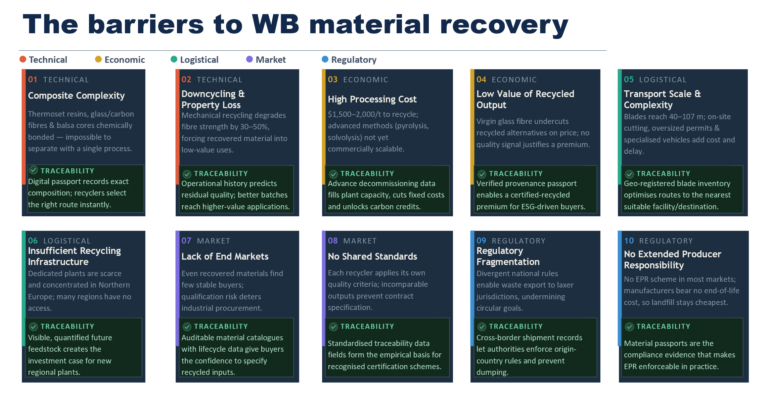
Barriers to wind turbine blade material recovery.
During our recent stakeholder workshop, David Garcia Estevez of TECNALIA discussed the objectives and current status of the REFRESH traceability platform.
Watch a recording of the presentation TURNING WASTE INTO ASSETS THROUGH TRACEABILITY.
[*The following is an edited transcript of the presentation recording.]
What is traceability?
Several barriers are usually identified when considering a wind turbine blade’s material recovery – technical, economic, logistical, market, and regulatory. For example, the heterogeneity and complexity of the composites is one of the barriers that limit their recycling and valorisation. We are dealing with a material that is still costly to process and the economic value of the recovered output is low. So sometimes it is not feasible from an economical point of view to use certain recycling options.
But for each of these barriers there is something that traceability can provide benefits.
Traceability is the missing digital layer that we need to facilitate the circularity of these materials. TECNALIA has been working in almost 10 projects in the last 10 years about wind blade recycling and circularity opportunities for products made of composites in general. One of the things we need to enhance is the confidence of the final users in the recovered products and traceability can help with this.
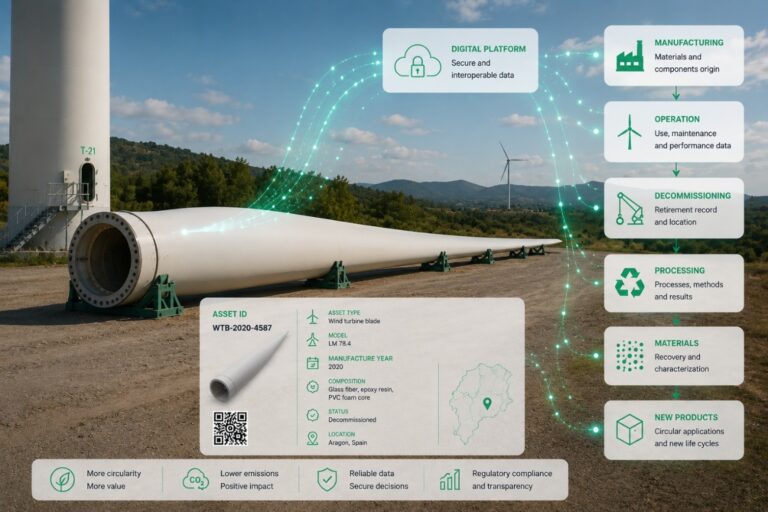
Traceability is the ability to track and document every stage of a material’s life – from raw source to final destination.
Traceability is a term that for certain organisations can be limited to fulfilling legal requirements, but this is not enough to increase circularity opportunities. For us, traceability is the ability to track and document every stage, or at least the necessary stages, of a product life cycle.
The REFRESH traceability platform
So in REFRESH we have applied this to the stages from the decommissioning of the blade until the recovered materials have been consumed or used by third parties. We think that this turns waste into valuable resources.
The tool that we are developing includes the traceability of the blades and all the resulting assets, the resulting materials, components, etc. We record the transactions and changes in ownership, we can declare and use several processing options with some data from the project for automatic calculations of LCA indicators and others, and we can provide information about the location and tracking of the different assets.
This provides several benefits. Perhaps the most evident are an enhanced quality control, and control in general, about the composition and information of those products and a much better decision making based on actual data.
The data used in this platform is based on the project results, which means that for the first stages in the value chain we are using quite close to market data (the first cutting on the blades, the first mechanical recycling, …), while for those stages that are still a more lower TRL we are using some estimations and some preliminary screening data that can be updated in the future. We are using blockchain technology for this platform, but blockchain has some requirements in terms of computation, effort, etc., so most of the data is stored off chain.
And from the user’s perspective, we have developed a web application that we can use it directly from our smartphones, from an internet browser, … and we are including several functionalities to facilitate that data entrance.
We assume that nobody wants to spend their time entering manually data about the blades and the assets, so most of the information is quite easy to select from some lists that are connected to databases that include blade models, manufacturers, etc. from Spain, south of France and Portugal. Manufacturers are a little reluctant to to share detailed information about their blades, but some information is publicly available and we have included that in the platform.
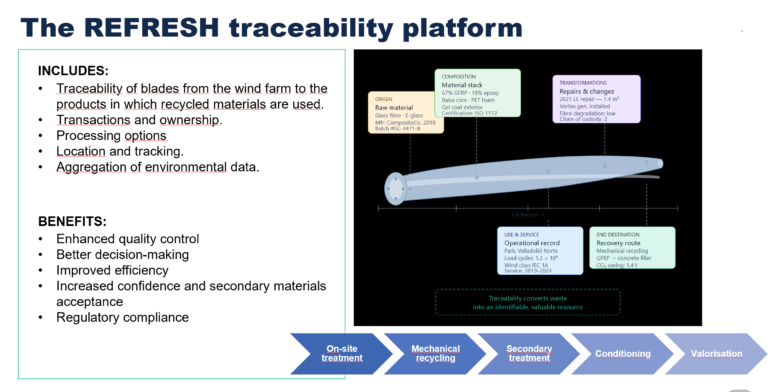
The REFRESH traceability platform.
The platform automatically calculates the weight of the resulting assets, and we select the most relevant impact categories for LCAs, so the tool is able to provide an automatic way accurate estimations or accurate quantification of those indicators. We can see at any time information of the previous assets, processes and owners for any asset. In addition to this, the users can also attach additional information to any of the blades or the assets.
Next steps
The tool is already functional. A first version was finalised at the end of last year and at this moment we are preparing the next validation at TRL 6. We will develop some training and trials with the project participants. We will try to replicate the different roles we have in the project for the different roles for the platform. In the coming months we will have additional information from the project results – on the recycling and processing technologies, solutions for repurposing and also products using the the recovered materials – so we will update the internal databases with this information.
Based on the user experience and the feedback from the project partners we will implement further functionalities and in the coming months we will look for opportunities to replicate this platform in other sectors. Several traceability platforms are being launched into the market, and there are some that cover the first stages in the blade’s life, but none are covering in such a complete way the stages from the end of life of the blades until the recovered materials are consumed in third applications.
DOWNLOAD THE PRESENTATION SLIDES
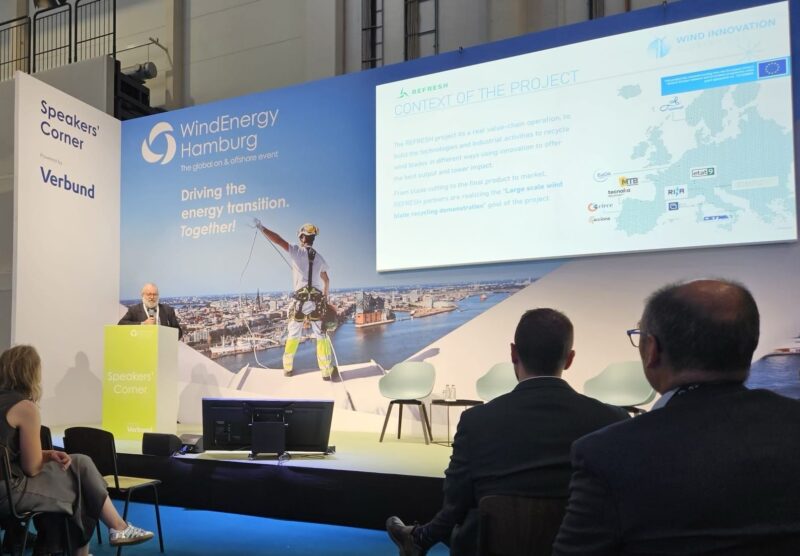
Gees Recycling presents REFRESH at WindEnergy Hamburg
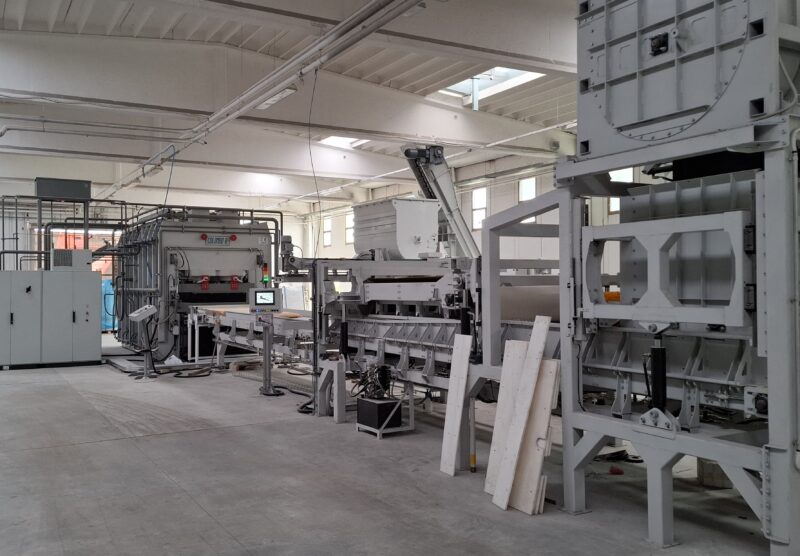
REFRESH participates in WindEnergy Hamburg as member of Wind Innovation Cluster Hub